Physical Address
304 North Cardinal St.
Dorchester Center, MA 02124
Physical Address
304 North Cardinal St.
Dorchester Center, MA 02124

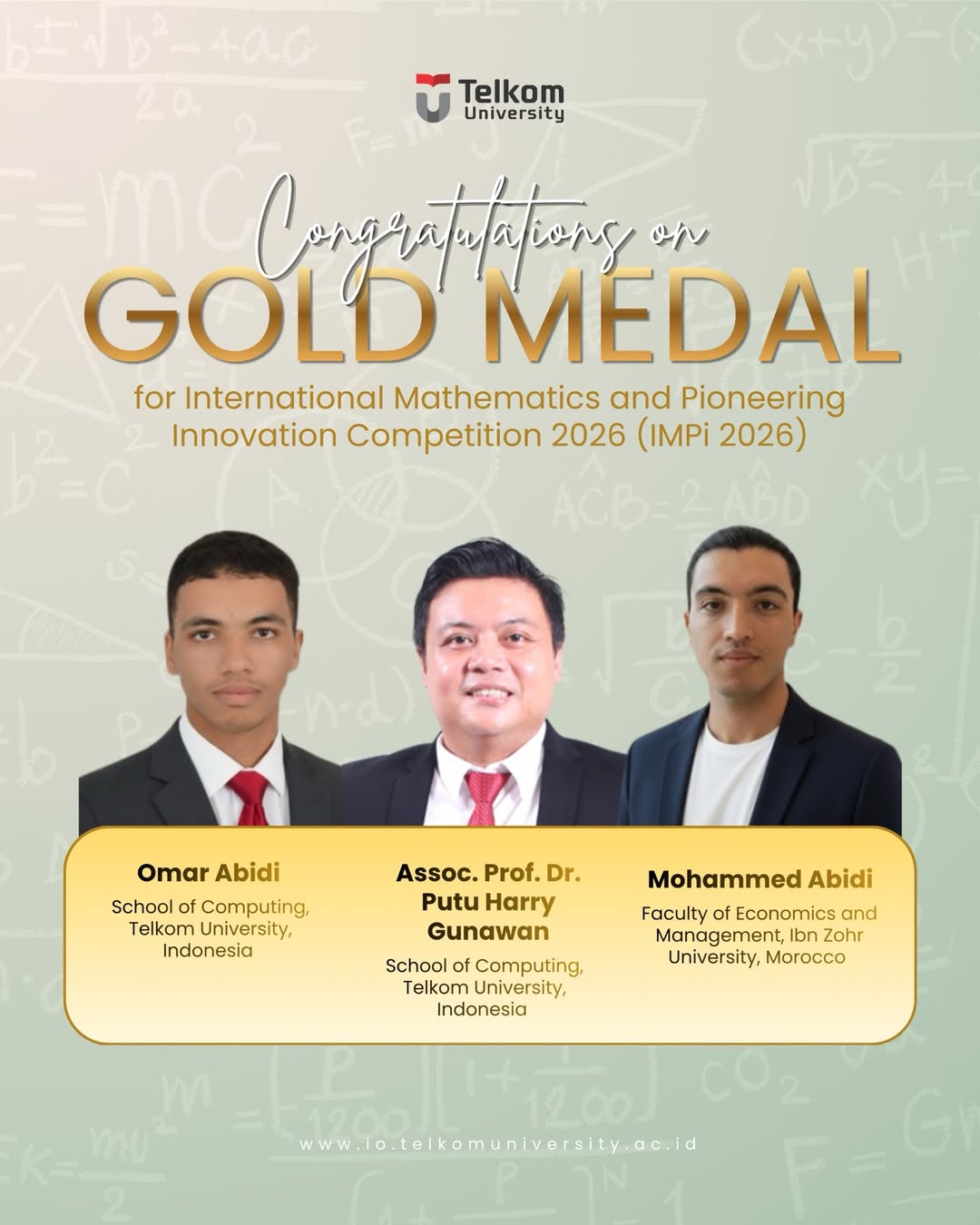
Three months ago, I made a decision that seemed reckless to some: compete internationally with an AI-powered iOS app while navigating my first year at Telkom University. Last week, that decision earned MathSolver Pro a Gold Award at the International Mathematics and Pioneering Innovation Competition (IMPi 2026), organized by Universiti Teknologi MARA (UiTM) Malaysia.
But this story isn’t really about winning. It’s about what happens when you stop treating university and entrepreneurship as separate tracks — and start building products that solve real problems.
As someone who’s built 80+ mobile applications before coming to Telkom, I’ve learned one thing: download numbers don’t mean impact. You can have 100,000 installs and still wonder if anyone actually learned anything from your app.
When I discovered the IMPi 2026 competition — focused on mathematics and pioneering innovation — I saw an opportunity to build something different. Not another productivity app or game, but a tool that genuinely helps students understand math, not just get answers.
MathSolver Pro became that tool: an AI-powered learning companion offering step-by-step explanations across 11 modules — equation solving, graphing, calculus, physics, statistics, and more. Every solution includes Claude-powered explanations that break down why each step works, not just what the answer is.
Here’s what nobody tells you about competing internationally while being a full-time student: the deadlines don’t care about your exam schedule.
I submitted the IMPi package during the same weeks I had midterms in Database Modeling, Matrix & Vectors, Computer Organization, and Calculus II. The irony wasn’t lost on me — I was building a math tutoring app while studying for my own math exams.
But that overlap turned out to be the best validation I could ask for. When you’re debugging a calculus module at 2 AM because you need to understand convergence tests for your own exam the next morning, you learn exactly what students actually struggle with. MathSolver Pro’s explanations got better because I was using my own product to learn.
This might surprise people who know I’ve published dozens of Android apps: MathSolver Pro is iOS-only.
The decision was deliberate. I rebuilt my entire development approach around SwiftUI and Apple’s ecosystem because I wanted to prove something — that a first-year student from Indonesia could build production-grade iOS applications that compete globally.
The App Store approval process alone taught me more about software quality standards than any textbook. I dealt with rejection after rejection: Sign in with Apple bugs, App Tracking Transparency implementation issues, Firebase configuration mismatches. Each rejection made the product stronger.
Winning gold at IMPi 2026 isn’t just a certificate to add to my CV. It’s external validation that MathSolver Pro solves a real problem in a way that judges from a leading Malaysian university found genuinely innovative.
The competition evaluated us on technical implementation, educational impact, innovation, and presentation. Competing against university students from across Southeast Asia and beyond meant our submission had to be more than functional — it had to demonstrate thought leadership in AI-powered education.
This achievement is shared with my co-developer Mohammed Abidi (Co-Director, Appspring Studio Ltd) and our supervisor, Assoc. Prof. Dr. Putu Harry Gunawan. Their support turned an ambitious idea into a product ready for international scrutiny.
If there’s one thing I want other students to take from this story, it’s this: you don’t need to wait until you’re in your final year to build something that matters.
The tools are available now. The competitions are open now. The problems worth solving exist now.
You’re already learning algorithms, databases, and software engineering in class. Use that knowledge to build products, enter competitions, and test your skills against international standards. The gap between “student project” and “real product” is smaller than you think — it’s mostly about whether you’re willing to handle rejection and keep iterating.
I’m representing both Morocco 🇲🇦 and Indonesia 🇮🇩 at these competitions, and I’m proud to do it as a Telkom University student. Our IABEE-accredited program gives us the technical foundation to compete globally — it’s up to us to take that foundation and build something with it.